

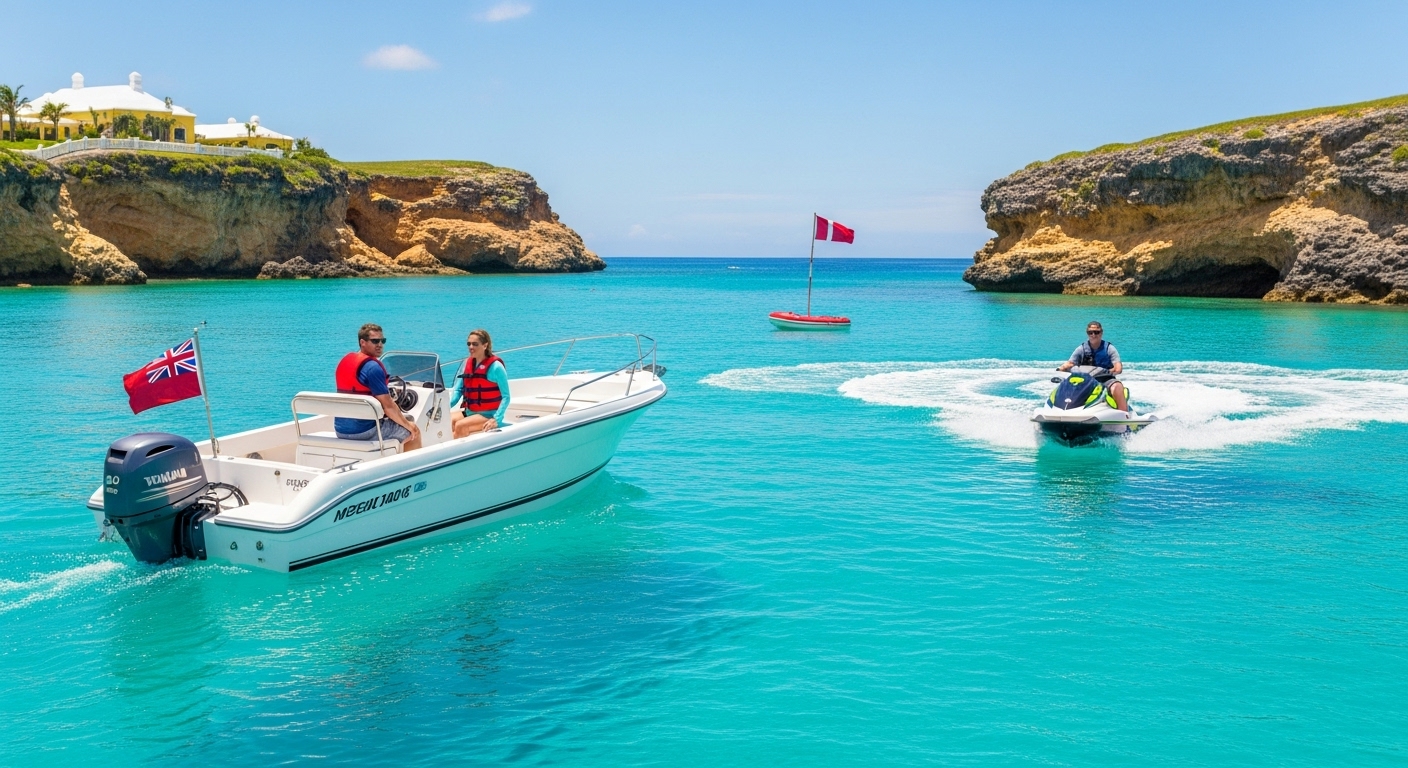
Watercraft Safety in Bermuda
Watercraft safety in Bermuda requires adherence to regulations for required safety equipment like lifebuoys and horns, compliance with speed limits in no-wake zones, and knowledge of specific environmental rules such as anchoring on designated moorings and maintaining a safe distance from marine mammals. It’s also crucial for all boat operators to understand Bermuda’s specific marine laws and regulations.
General safety equipment
• Lifebuoys: Mandatory on all “Island Boats” (except rental boats). The number required depends on the boat’s length: one for boats up to 40 feet, two for boats over 40 feet, and four for boats over 60 feet.
• Lifebuoy with line: Lifebuoys must have at least 50 feet of buoyant line. If operating at night, at least one lifebuoy must have a self- activating light.
• Signaling mirror: Shall be equipped on every Island Boat.
• Horn: Every Island Boat must carry a suitable fixed horn.
• Life-rafts/Buoyant Apparatus: Required for vessels operating outside the outer reef edge.
These must be a minimum of 100% of the licensed passenger capacity and must be SOLAS standard, inspected annually if inflatable, and in good condition.
Operational rules
• No-wake zones: It is illegal to travel faster than 5 knots or create a wake within 100 meters of the shoreline, with some exceptions.
• Anchoring: You must use permanent mooring buoys where available to prevent damage to the coral reefs. Avoid anchoring on the reef itself.
• Marine mammal regulations: Stay informed about and follow all marine mammal regulations, including maintaining a safe distance from marine life such as whales.
• Mooring licenses: Moorings must be registered, paid for, and display the correct registration decal. It is illegal to use a mooring without a current license or to exceed the boat size restriction for that specific mooring without prior permission.
Getting licensed and educated
• Introductory course: An introductory boating course is available to help individuals quickly obtain an A&B marine navigation license, covering regulations, knots, docking, and navigation.
• Code of Practice: “Island (Charter) Boats” operate under a Code of Practice, which ensures basic safety and operational levels within the industry.
Environmental protection
• Mooring buoys: The use of mooring buoys helps eliminate anchor damage to Bermuda’s delicate reefs.
• No fishing: Some designated mooring sites are “No Fishing Areas”.
• Registration: All floating docks, swim rafts, and mooring piles must be registered and display a current decal to be considered legal.
Watercraft safety in Bermuda is governed by the Marine Board (Safety) Regulations 1993, enforced by local authorities. Key regulations cover mandatory safety equipment, speed limits, and responsible operation.
Mandatory Safety Equipment
All non-rental boats (except small rowing boats/canoes) must carry specific safety gear, which varies by boat length:
Boat safety equipment requirements in Bermuda vary based on boat length. For boats less than 20 feet and boats between 20-40 feet, mandatory items include one approved life jacket for each person, two oars or paddles, and a sound-producing device. Other requirements depend on the size of the boat.
For instance, boats under 20 feet need a bailer or manual bilge pump, an anchor with 3 feet of chain and 100 feet of rope, and a flashlight. Boats between 20-40 feet require both a bailer and a manual bilge pump, an anchor with 5 feet of chain and 200 feet of rope, a flashlight, specific flares and signaling equipment, and two lifebuoys. Power-driven boats or those with cooking/heating appliances must also carry fire extinguishers.
Operational Rules and Guidelines
• Speed Limits: Operating a boat within 100 meters (approximately 330 feet) of the shoreline at over 5 knots or creating a wake is illegal.
• Alcohol/Drugs: It is against the law to operate a marine vessel while under the influence of alcohol or drugs.
• Whale Watching: Maintain a safe distance from marine life, typically 200 meters for boats and 300 meters for jet skis when near whales.
• Water Skiing: When water skiing, the towing boat must have two people over 16: a driver and a lookout. Skiers should remain at least 200 feet from the foreshore and wear a life jacket or buoyant belt.
• Right of Way: Ships in Bermuda’s territorial waters have priority over smaller local boats.
• Float Plan: Before a trip, submit a float plan to Bermuda Harbour Radio (441-297-1010) or inform someone responsible about your destination and expected return time.
• Inspections: All safety equipment must be functional. Inflatable life- rafts require annual inspection and certification by a recognized service agent.
Key Contact Numbers
• Bermuda Harbour Radio /
Maritime Rescue: 441-297-1010 or emergency services
• Marine Police: Contact via VHF Channel 16
• NOAA (for whale sightings/collisions): 877-WHALE-HELP (942-5343)
